My shop CONTAINED EXUBERANCE is closed for regular retail hours during winter.
BUT, you can still book garden consultations and buy garden pottery and decor by appointment.
CALL or TEXT: Bob Hyland at 518.929.0699
EMAIL: bobhylandgardens@gmail.com
My shop CONTAINED EXUBERANCE is closed for regular retail hours during winter.
BUT, you can still book garden consultations and buy garden pottery and decor by appointment.
CALL or TEXT: Bob Hyland at 518.929.0699
EMAIL: bobhylandgardens@gmail.com
Summer is my favorite time in the garden. Long, warm days to kick back and enjoy a bounty of flowers and foliage in a rainbow of color.
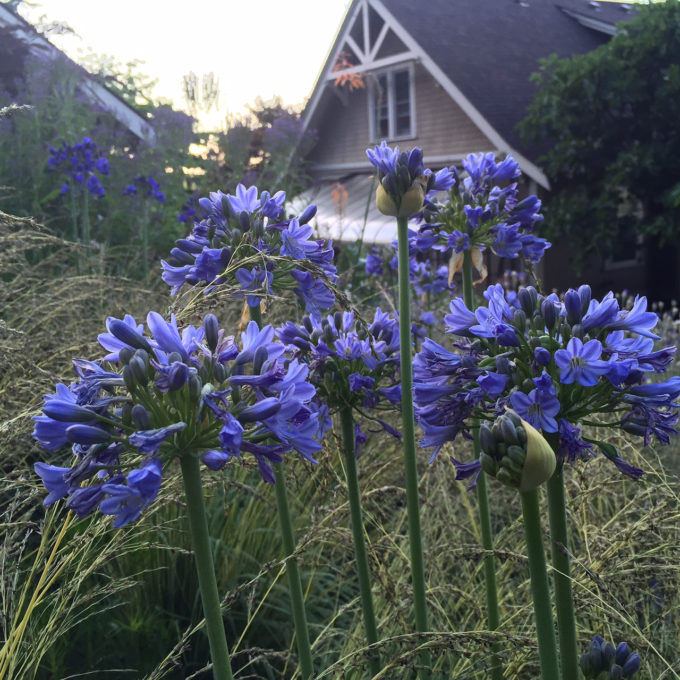
Blue is the #1 favorite color of all people. It is nature’s color for water and sky, embraced as the hue of heaven and authority, and worn universally in denim clothing. In my garden, Agapanthus ‘Joyful Blue’ is beginning to bloom…shooting up through a sea of Molinia caerulea ‘Variegata’.
Gardeners have a fascination with “true” blue flowers in the garden. We are enticed by photos of Himalayan blue poppies (Meconospis spp.) and promises of an endless summer of blue mophead hydrangeas or a lacecap like Hydrangea serrata ‘Bluebird’.
In our warm, dry, intensely bright Pacific Northwest summers, blue flowers, fruits, and foliage offer calming relief. For backdrop in my own garden, we’ve planted a few leafy blue evergreen trees, notably Cunninghamia lanceolata ‘Glauca’ with its fat, wide frosty blue needles and Eucalyptus pauciflora subsp. debuzevillei, a large-leaved version of the snow gum with chalky blue leaves that contrast nicely with its earth-toned copper-pink-green-white patchwork bark.
For blue summer fruit, nothing beats edible blueberries, either lowbush (Vaccinium angustifolium) or highbush (Vaccinium corymbosum). I am still amazed at the mind-blowing blueberry selections available to HPSO gardeners in Portland regional nurseries. Aside from the juicy summer fruit, multi-stemmed blueberries offer deciduous leaves that turn bright yellow, orange, and vibrant shades of red in autumn.
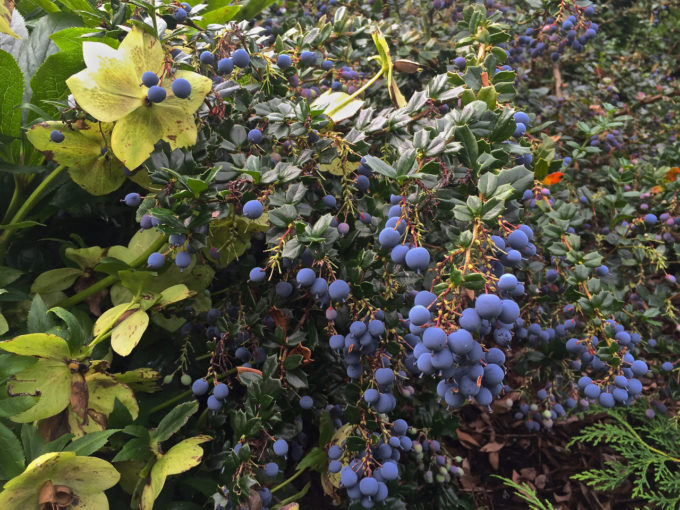
Oregon-grape (Mahonia (synonym:Berberis) aquifolium) is our state flower – yellow spring blooms that yield clusters of round, dusky blue summer fruit. The tart, edible berries don’t offer the same sweetness of fresh-picked blueberries, but who cares! Mahonia is a dynamic shrub with 4-season interest, particularly hybrid varieties like M. x media ‘Arthur Menzies’, ‘Charity’, ‘Lionel Fortescue’ and ‘Winter Sun’. No garden should be without one…or two!
Another favorite blue-fruiting shrub in our garden is Berberis darwinii. Remarkable clusters of intense blue fruit ripen in summer…and freshen up fading hellebore flowers.
I delight in all forms of California lilac (Ceanothus) and their adaptability to our dry summers. Perhaps my new favorite is Ceanothus x ‘Topaz’, a great summer-bloomer with some of the darkest, deep blue-black flowers in the genus. Flower trusses on ‘Topaz’ are loose and airy, lending informality in the summer garden.
Among blue-flowering perennials, several really sing in summer. Penstemon heterophyllus ‘Electric Blue’ leads the parade. Its zappy true blue flowers smother the foliage for up to six weeks in late spring and then sporadically through summer with some deadheading.
Lithodora diffusa ‘Grace Ward’ may seem a rather common box store perennial, but its flowers are among the most intense deep blue. It is a wonderful groundcover or rock garden accent with sprawling to slightly mounded form.
On our northwest Portland hillside, two blue-flowered perennials dominate the summer scene. Catananche caerulea (Cupid’s dart) grows in clumps of narrow gray-green foliage with wiry flower stems of cornflower blue to violet-lavender fringed daisies. Catananche is a dynamic bedfellow with Molinia caerulea ‘Variegata’ on one of our terraces.
My other newly favored perennial is Agapanthus with strappy green foliage down on the ground and aerial globes of powder blue, royal, and blue-black that drift across our summer plantings. Standouts are Agapanthus ‘Joyful Blue’ with soft blue flower heads fading to a milky lavender (a Joy Creek Nursery selection) and A. ‘Blue Leap’, a vigorous, hardy variety chosen for its ability to “leap” across our hillside. We purchased ‘Blue Leap’ from Dan Hinkley at Windcliff Plants. Dan originally selected and introduced ‘Blue Leap’ through Heronswood Nursery.
I use grasses and sedges liberally in my garden designs to knit plantings together at the ground plane. Many are blue-bladed like little bluestem (Schizachryrium scoparium ‘The Blues’), blue oat grass (Helictotrichon sempervirens ‘Sapphire’), blue fescue (Festuca ovina ‘Elijah Blue’) and blue sedge (Carex flacca ‘Blue Zinger’). I’m discovering the merits and best use of native Festuca californica and the South American blue wheat grass (Agropyron magellanica) which froms a striking evergreen clump of intense blue foliage. A couple of blue-foliaged perennials like Euphorbia rigida, Parahebe perfoliata (Digger’s speedwell), and Agastache ‘Blue Boa’ work wonderfully spiking up through some of these blue grasses and sedges. Blue foliage, flowers, and fruits offer cool summer moments, and at the same time make your garden ZING.
Saturday, September 24th at 11:00 am
1114 SE Clay Street, Portland, OR 97214
Paul Bonine, co-owner of Xera Plants.
Invigorate your containers with plantings for maximum fall and winter enjoyment.
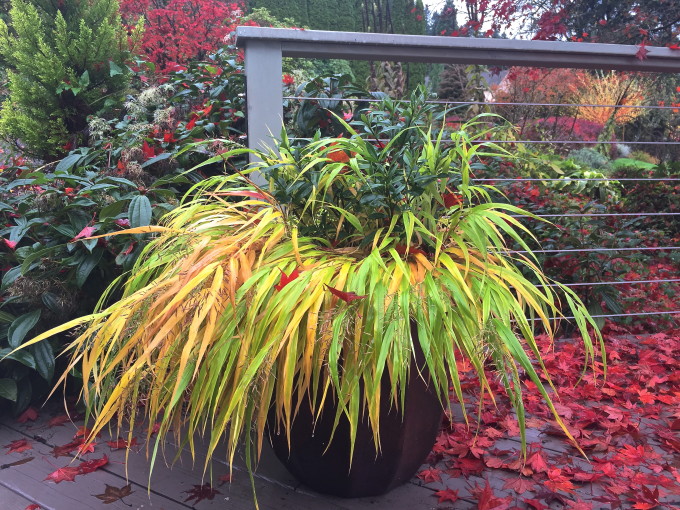
Unlike the title and refrain from the 1974 pop hit Mellow Yellow by Donovan, YELLOW flowers and foliage in the garden are cheerful, sunny, and uplifting. Yellow can be seductively pale; yummy, bright, and buttery; punchy and fluorescent; in-your-face brassy; or screaming acid yellow.
In color theory, yellow is a primary color, along with red and blue. Green, orange, and purple are colors formed by mixing primary colors. Mixing primary and secondary colors yields tertiary colors or hues given a hyphenated two-word name, such as yellow-green or yellow-orange. There are more shades of yellow than any other color (check out any good paint line) with descriptive names like Canary, Goldfinch, Golden Honey, Sun Kissed, Tuscan Sun to name just a few!
The parade of yellow starts early in our northwest Portland garden with winter- and spring-blooming shrubs. Chimonanthus praecox (wintersweet) starts the show January-February with waxy butter yellow flowers (almost translucent) accented with maroon on the inside. There is nothing quite like the spicy, pungent smell of winterweet on a cold, damp Portland winter day. Next up are the spidery blooms of hybrid witch-hazels. My favorite for yellow color and sweet, subtle aroma is Hamamelis mollis ‘Pallida’ with wavy ever-soft yellow petals brilliantly displayed on bare branches. A close runner-up is Hamamelis x intermedia ‘Arnold Promise’ with its sturdy vase-shaped habit and clear, almost “true” yellow spidery flowers. HPSO member Lucy Hardiman has a champion specimen in her southeast Portland garden.
Overlapping and taking the lead from witch-hazels in bloom sequence are two other favored yellow-flowering shrubs – Edgeworthia chrysantha (Chinese paperbush) and Corylopsis spicata ‘Aurea’ (golden spike winterhazel). Edgeworthia produces deliciously scented umbels of yellow tubular flowers on thick, naked branches. Golden Corylopsis provides a double-whammy of dangling pale yellow flowers followed by acid yellow leaves that shift bright gold to chartreuse late in the season.
Another remarkable yellow-blooming shrub is Stachyurus salicifolius (willowleaf spiketail). It’s a lovely graceful, arching evergreen shrub from China with long willowy evergreen leaves. In early spring chains of creamy yellow bell-shaped flowers are guaranteed to start a conversation.
It’s not all about colorful blooms, however. Flowers are fleeting and foliage rides much longer during the gardening season. An excellent example is Ribes sanguineum ‘Brocklebankii’, a golden yellow-leafed form or our native flowering currant. It has typical trusses of dark pink flowers in early spring accented against the warm foliage. Too much sun can burn the leaves so a lightly shaded spot or morning sun is best. Another currant that I am crazy about is Ribes odoratum (clove currant) and the cultivar ‘Crandall’. Both sport golden yellow trumpet-shaped flowers in racemes in spring and emit a strong, spicy, clove-like fragrance. The punchy flower color and fragrance is to die for!
Down lower to the ground, there are many perennial plants that I wouldn’t be without for their yellow springtime color. Euphorbias of all kinds lead the list, in particular architectural Euphorbia rigida with its stiff upright stems clothed in long, pointed, powder-blue leaves topped by fluourescent yellow-green flower heads. Another favorite is Euphorbia polychroma ‘Bonfire’, an herbaceous cushion spurge whose new foliage emerges deep red-purple shifting to burgundy in mid summer. The low-mounded foliage to 1.5 foot tall is covered by fluorescent yellow to chartreuse bracts. For softer yellow perennial flower color, Scabiosa ochreleuca (pincushion flower) is a bringer of bees and butterflies, practically everblooming, and drought and deer resistant. Hundreds of 1.5” soft primrose blooms cover the multi-branching, 3-foot-tall stems.
I liberally use ornamental grasses and sedges in my naturalistic garden designs to knit together and integrate plantings. One of my favorite workhorses for full sun is Molinia caerulea ‘Variegata’ (variegated purple moor grass) This tufted, compact perennial has dense clumps of slender, foot-long green leaves marked with stripes of creamy yellow. In summer, slim, pale yellow flower stalks rise up 3 feet tall in a vertical pattern that glows when backlit by the sun. Molinia combines well on one of our hillside gardenslopes with the complementary cornflower blue blooms of Catananche caerulea. In the shade, I am fond of Carex oshimensis Everillo (EverColor R), a Japanese sedge with fantastic bright lime-green foliage that ages to golden yellow during the season. I wouldn’t be without Japanese Hakonechloa macra ‘Aureola’ and ‘All Gold’. Likewise, Luzula sylvatica ‘Aurea’ (great woodrush) with bright golden foliage in late winter and early spring fading to lime-green by midsummer.
For a big bold, ever-present yellow statement in my gardens, I always find room for a specimen or clusters of Yucca filamentosa ‘Color Guard’, my favorite golden yellow-centered variegated yucca, and Symphytum x uplandicum ‘Axminster Gold’ (yellow variegated comfrey) with large, coarse grayish green leaves artfully edged in vibrant lemon-yellow.
Yellow is a happy color that brightens and lifts gardens and souls during the spring renaissance in our gardens.
Join me and fellow Portland Metro region garden and container designers for FREE Saturday morning workshops and container planting demonstrations.
Workshop Limit: 20
FREE ADMISSION plus 10% discount coupon for purchases at Contained Exuberance
Pre-register for these workshops using contact form under “My Shop” drop down at www.hylandgardendesign.com or phone/text 518.929.0699
With Kate Bryant, garden writer, designer, and horticultural consultant. Get ideas and strategies for early explosions of color, texture and pizzazz in your garden containers. Jumpstart the season!
With Lucy Hardiman, principal and owner of the dynamic Portland-based garden design collaborative Perennial Partners. Pick up tips and observe techniques from a master gardener of container plantings that maximize visual appeal and ease of maintenance.
With Lenore Rice, co-owner of Seibert & Rice, leading American importer of handmade terracotta planters and urns from Italy. Learn about the merits and advantages of high-fired, frost-proof terra cotta pots…the best money can buy! Traditional, classic designs, and artistic, one-of-a-kind pots.
With Claire Bandfield, artist, craftswoman, pot-maker. Meet-greet and hear about locally made, LIGHTWEIGHT, beautifully crafted pots for succulents, airplants, and Japanese-inspired plantings.
With Lynn Wolfstone, Portland garden designer and past president of APLD (Association of Professional Landscape Designers). Get great ideas on how to invigorate and refresh containers with plantings and accessories for maximum outdoor summer enjoyment.
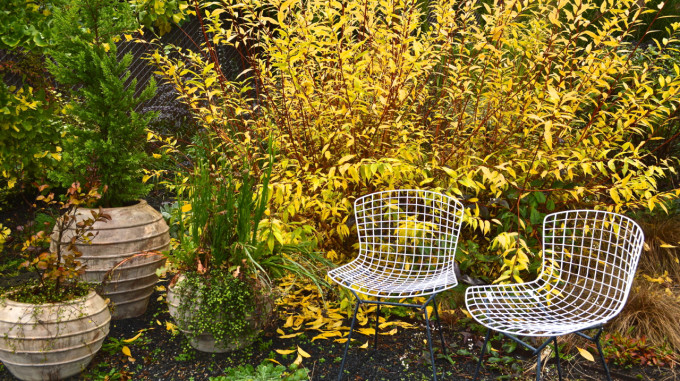
Fall is in full-swing here in Portland, OR. The brilliant yellow leaf color of Salix ‘Flame’ is good background for an outdoor seating area decorated with pots. Brilliant orange-red stems follow for months of winter enjoyment.
Vintage mid-century modern side chairs by Harry Bertoia (circa 1952) and a trio of Antico terra cotta pots complete the decor.
Clearing room for new 2016 inventory. Savings at 40% off on earthenware, terracotta, cast stone, and poly-resin pots (some fountains, too!)
My Shop, CONTAINED EXUBERANCE, is OPEN by appointment only from November-Feburary. Call 518.929.0699 to schedule.
POTS with PATTERN & TEXTURE
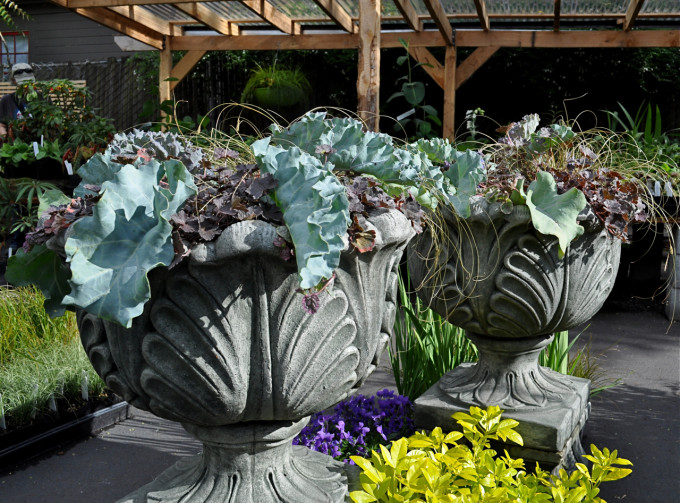
BELOW: Cast stone LEAF POTS on pedestals; planted with Crambe maritima, Geranium sessiliflorum ‘Red Select’ & Carex comans ‘Olive Oil’
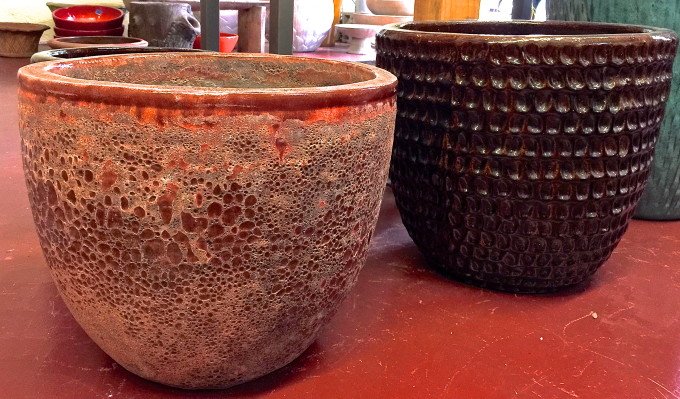
BELOW: (L) Aspera Planter in Angkor Red glaze; (R) Dimple Glaze Planter in Cognac glaze
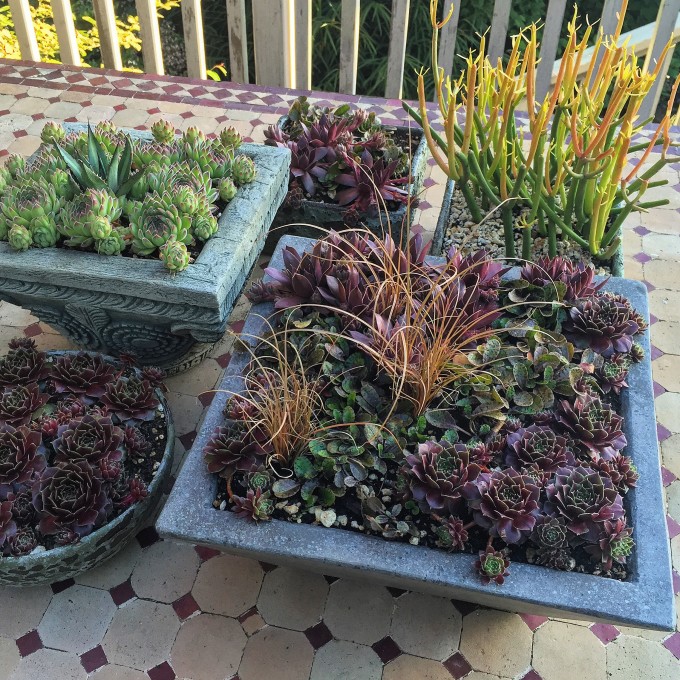
After an exceptionally long, hot, dry summer in Portland, the containers that look best in my Shop and home garden are succulent combinations of all kinds. They have lower irrigation needs and more forgiving in the heat.
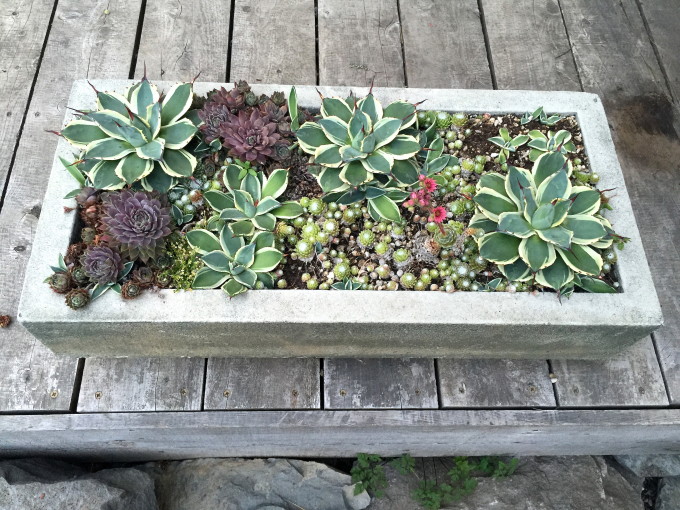
I like to plant shallow bowls of hardy Sempervivum (hens-and-chicks), Sedum, Delosperma and (ice plant) in artful, naturalistic patterns. Tender Agave, Crassula, Aeonium, and Echeveria are favorites, although they require winter protection during Pacific Northwest winters.
MY STYLE: It Takes Three! Three well-chosen plants make artful container compositions. I avoid hodgepodges of one-of-a-kind plants and collections. That’s my personal take…you can develop your own.
20% OFF everything at Hyland Garden Design’s CONTAINED EXUBERANCE Shop, 1114 SE Clay St., Portland, OR.
OK… so there’s always a few exception: “planted pots” & floor-model fountains are EXCLUDED.
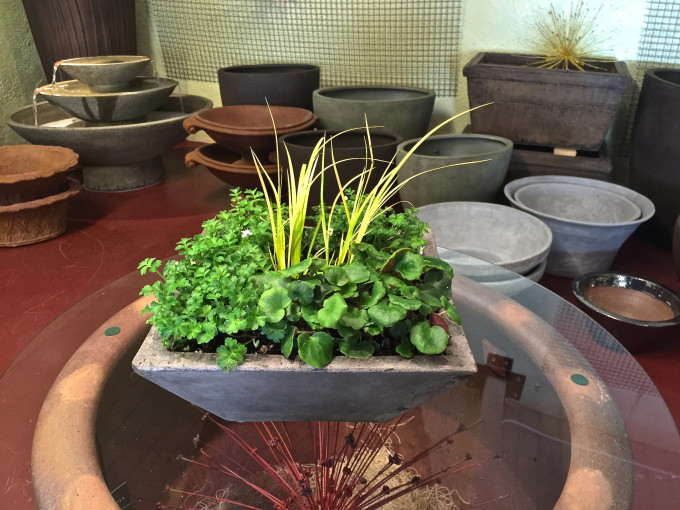
WHAT you’ll find:
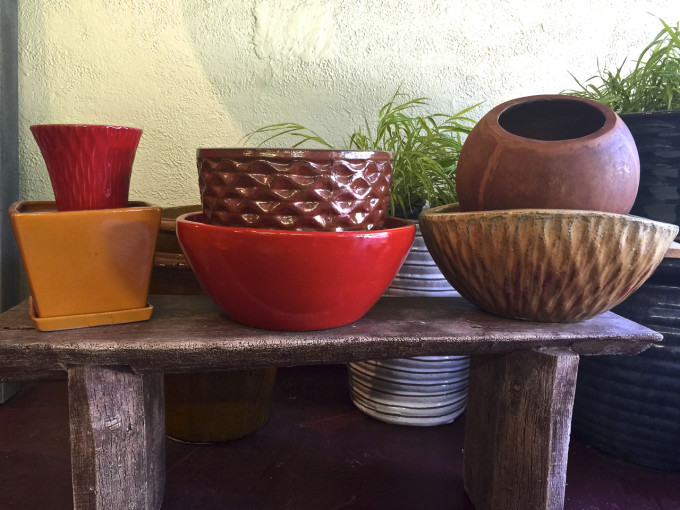
We’re having another HEAT WAVE in Portland… celebrate with glazed pots in HOT colors.
Beat the heat in my “cooler” shop space, splash around in the fountains, and layaway some pots at GREAT savings.
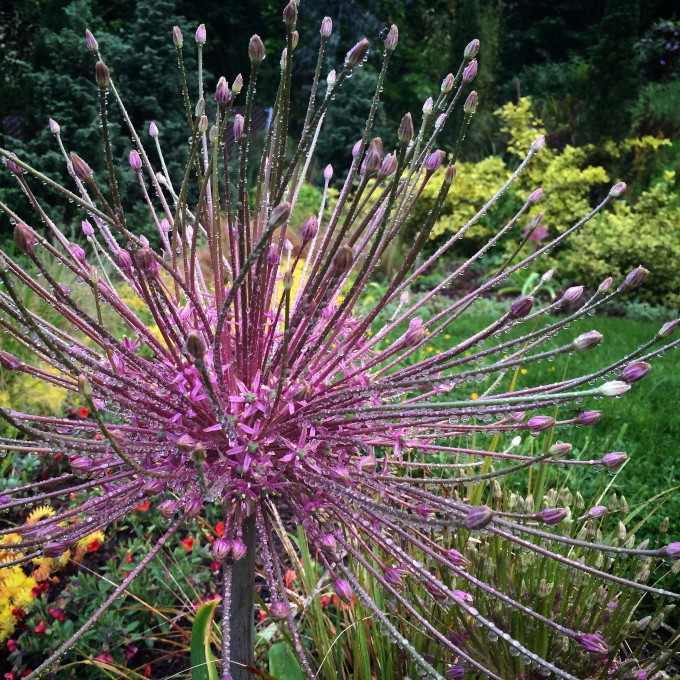
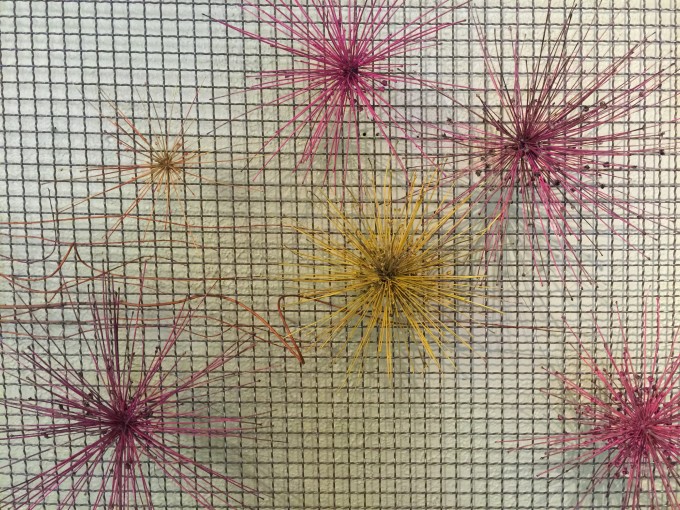
Allium schubertii may have faded in color on our hillside borders, but the strong architecture persists. If I need a dose of color, I artfully spray paint some in place in the garden and elevate them above other plantings on bamboo stakes.
Others are collected, spray-painted, and hung on a wire grid on the back wall of my Portland, Oregon shop.
EASY, conversation pieces outdoors and in your home.
Buy Allium schubertii bulbs for fall planting and you’ll have your own “living” 4th of July fireworks next year.